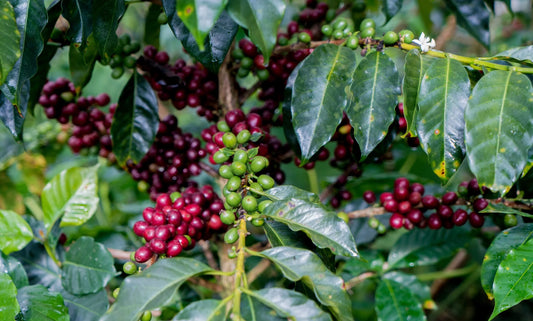
Coffee Growing in the Peruvian Andes
Peru is one of the world's important Arabica-producing countries, with coffee grown along the eastern slopes of the Andes across a remarkable range of elevations, climates, and regions. Much of the country's coffee is produced by smallholder farmers working relatively small plots, often in mountainous areas where harvesting and transporting coffee can require considerable hands-on work.
Peruvian coffee is sometimes described simply as mild or approachable, but that doesn't capture its full range. Depending on region, variety, processing, and roast development, coffees from Peru can offer chocolate and caramel sweetness, nuts, citrus, stone fruit, floral character, lively acidity, and much more.
At Staccato Roasters, we especially value Peruvian coffees that combine sweetness and balance with enough individual character to remain interesting in the cup.
Where Is Coffee Grown in Peru?
Coffee production stretches across numerous regions along Peru's Andean coffee-growing belt. Important producing areas include Cajamarca in northern Peru, as well as Amazonas, San Martín, Junín, Cusco, and other regions with suitable elevations and climates.
The steep terrain creates a patchwork of growing environments rather than one uniform "Peruvian" terroir. Elevation, rainfall, temperature, soil, shade, variety, and local processing practices can all influence how a particular coffee develops.
Our current Peru Cajamarca Coffee Beans come from Cajamarca, a northern region that has become particularly important to Peru's specialty-coffee production.
Why Are Peru's Growing Conditions Good for Coffee?
Many Peruvian coffee farms sit at substantial elevations in mountainous environments. At higher elevations, cooler temperatures can slow coffee-cherry maturation. Given suitable varieties and farm conditions, that slower development can contribute to dense seeds and complex flavor development.
The Andes also create dramatic differences in elevation and microclimate over relatively short distances. Two coffees grown in Peru—or even within the same broad region—can therefore taste noticeably different.
This is one reason we prefer to think about Peru not as a single flavor profile, but as an origin capable of producing a wide range of coffees.
A Brief History of Coffee in Peru
Coffee has been grown in Peru for centuries, becoming an increasingly important agricultural crop as production expanded during the nineteenth and twentieth centuries. Over time, coffee became an important source of income for farming communities across the country's coffee-growing regions.
Today, much of Peru's coffee sector continues to be built around smallholder production. Cooperatives, producer organizations, exporters, importers, and specialty buyers can all play roles in connecting coffees grown in remote mountain communities with roasters and coffee drinkers around the world.
Peru has also developed a growing reputation in specialty coffee as greater attention has been paid to individual regions, producers, varieties, processing, traceability, and cup quality.
What Does Peruvian Coffee Taste Like?
There isn't one flavor that defines coffee from Peru. Depending on the coffee, you may encounter characteristics such as:
- Chocolate and cocoa
- Caramel or brown-sugar sweetness
- Nuts
- Citrus and other fresh fruit
- Stone fruit
- Floral aromatics
- Balanced or lively acidity
- A clean, sweet finish
Some Peruvian coffees make exceptionally approachable everyday cups built around chocolate and sweetness. Others can be considerably brighter, more floral, or more fruit-forward. Processing, variety, growing conditions, and roasting all influence which characteristics ultimately become prominent.
Our Peru Cajamarca represents the more comforting side of that spectrum, with a roast approach developed around chocolate character, sweetness, balance, and a smooth finish.
How Is Peruvian Coffee Processed?
Washed processing is common in Peru. In a typical washed process, coffee cherries are harvested and the fruit is removed from the seeds before the coffee is fermented, washed, and dried. Done well, this approach can produce coffees with clean flavor separation, clarity, and defined acidity.
Natural and other processing methods can also be found in Peru, particularly as producers and specialty-coffee programs experiment with different approaches to fermentation and drying. Processing method alone does not determine flavor, but it can have a significant influence on how fruit, sweetness, acidity, and body are expressed in the cup.
Our current Peru Cajamarca is a washed coffee, which fits well with the clean, balanced profile we're trying to develop through roasting.
Common Coffee Varieties Grown in Peru
Peru grows numerous Arabica varieties, and the mix varies by region and farm. Commonly encountered varieties can include Typica, Bourbon, Caturra, Catimor, and others, alongside additional traditional and newer cultivars.
Variety matters, but it is only one piece of the finished cup. Growing conditions, plant health, cherry ripeness, processing, drying, storage, and roasting all interact with genetics to influence flavor.
That's why we prefer to evaluate each coffee as an individual lot rather than assuming that its country or variety tells us exactly how it should taste.
How We Roast Peruvian Coffee at Staccato
We develop the roast around the coffee rather than forcing every origin into a predetermined roast profile. With our current Peru Cajamarca, our goal is an approachable cup with chocolate character, sweetness, body, and enough acidity to keep the coffee lively and balanced.
That makes it a natural fit within our Medium Roast Coffee selection: developed enough to emphasize deeper sweetness and a smooth body without treating "dark" or "roasty" flavor as the objective.
A future Peruvian coffee could call for a different approach. The roast should follow what the individual coffee has to offer.
Explore Peruvian Coffee at Staccato Roasters
Our Peruvian coffees will change as harvests, lots, and seasonal availability change. This collection is the permanent home for coffees we source from Peru, whether they're comforting and chocolate-forward or brighter and more fruit-driven.
Explore the available coffees above, or start with our current Peru Cajamarca Coffee Beans.